- Inside Mongolia
- Posts
- 💣💥 When Power Clashes...
💣💥 When Power Clashes...
AI Integration in Mongolia

In partnership with

Wow… Hilton has announced the launch of Conrad Ulaanbaatar, set to open in 2028, marking the group’s entry into Mongolia’s hospitality market. Last year, Marriott International also announced its entry into Mongolia. Ulaanbaatar’s luxury hospitality era is loading. Habibi, come to UB. Spend some money. 😂🤑
What’s inside today’s edition…
🌶️ Parliament’s Spicy Spring Session
⚖️ Power Struggle at the Top
🤖 AI Integration in Mongolia
We’ve got a lot to cover, so let’s get moving. 🐐

MARKET
GOV: Cabinet approves cashmere industry support plan with export incentives and financing.
MNG: Parliament’s spring regular session, which the Justice Minister said would be “spicy,” will open today at 10:00 a.m., with the President scheduled to deliver a speech.
MOF: The government is proposing a sweeping tax reform package aimed at gradually reducing the tax burden on households and businesses by ₮ 2.7 trillion.

⚖️ When Power Clashes…

What is unfolding in Mongolian politics is the long-running reality of a 2-headed executive system, in which both the President and the Prime Minister (PM) carry competing political weight under the 1992 Constitution.
🎤 In his first public appearance since leaving office, ousted former PM L.Oyun-Erdene spoke about his fallout with the President, once his closest ally and key political backer, reflecting Mongolia’s long-running pattern of conflict between the presidency and the premiership.
🏛️ From President vs PM to President vs Parliament
The key highlight of the ex-PM’s interview was his argument that the main fault line is now shifting from President vs Prime Minister to President vs Parliament. As Mongolia moves closer to the 2027 presidential election, he argued, institutional pressure is intensifying. The ex-PM stressed that the President’s recent proposed draft law on the recall of Members of Parliament (MPs) is part of a broader effort to weaken Parliament’s independence and narrow the space for political competition ahead of the next electoral cycle.
🤕 In that framing, the issue is no longer only about who will control the presidency next, but whether Parliament can continue to function as a meaningful counterweight.
Another major theme was what could be called the MPP’s internal orchestration for the next presidency. Under the 2019 constitutional amendment, the President is elected for a single 6-year term. But according to the ex-PM, this is where his main conflict with President U.Khurelsukh began. He claimed the President was interested either in seeking another term through a fresh constitutional amendment or in returning to lead the MPP after leaving office.
⚠️ The “Tunnel” Concern
More concerning is the claim that both past and current Presidents have held the keys to the so-called “tunnel”, a system through which law enforcement and judicial processes can allegedly be influenced for political ends. In this telling, the “tunnel” functions as a tool of political engineering, especially ahead of major cycles such as the 2027 presidential election.
⛓️💥 For instance, it can allegedly be used to sideline rivals by launching or reviving cases, while also pressuring Parliament through legal and “moral” investigations aimed at winning support for measures such as the recall initiative.
Perhaps that is also why the ousted PM suddenly found his voice after stepping down. He may fear that he himself could be dragged through the same tunnel system.
🌀 The “vacuum” of power
Despite the constitutional requirement for the President to remain non-partisan, the ex-PM claims that the President’s office is effectively acting as the de facto leadership of the MPP. That, in turn, is creating friction with the party’s formal leadership as different factions position themselves for control over the 2027 political cycle.
Finally… Yes, the ousted PM was once seen as a political monster in his own right. But the system now on display may be far more dangerous than any one individual. Even when he held enormous power, he failed to carry out the meaningful reforms he is now criticizing. Even so, the broader point remains hard to ignore. Mongolia’s institutional sovereignty appears to be in crisis.
The core power-balancing institution, the judiciary, is claimed to be functioning like an authority’s magic wand. In a system skilled at mass manipulation, silencing those who challenge it becomes a direct threat to democracy’s survival. Unless that is exactly what people choose to tolerate.
⭐ Selected for you
ECONOMY & BUSINESS
Erdenet Mining Corporation Sets a New All-Time Record. (MSightl)
How the New Gulf War Is Impacting Mongolia. (TheDiplomat)
Mongolia Imported 12.2 Million Fresh Flowers in 2025. (FloralDaily)
Mongolia Urges Rio Tinto to Rewrite Terms of Oyu Tolgoi Copper Mine. (Reuters)
MIAT Intends to Add Ulaanbaatar, Erenhot Route in NS26. (AeroRoutes)
Oriental Brewery Plants 47,000 Trees in 16-Year Mongolian Project. (MSN)
Mom’s Touch Put Up for Sale Amid Profit Growth. (TheKoreanHerald)
POLITICS
Mongolia Chooses Main Cross-Border Route For Eurasian Economic Union Trade. (RussiasPivottoAsia)
The Government approved the draft loan agreement with the EBRD for the “Energy IV” project. (ESight)
Mongolia Aims to Renegotiate Loan for Copper Project with Rio Tinto. (BinanceSquare)
Draft laws on Housing and on the Housing Finance Bank Will be Submitted to Parliament. (BOM)
The Government will Submit a Revised Narcotics Control Bill to Parliament. (GOV)
CULTURE & LIFESTYLE
Mongolian Rock Trailblazers The Hu Unleash Thunderous New Anthem “The Real You”. (ThatEricAlper)
🦾 AI Integration in Mongolia
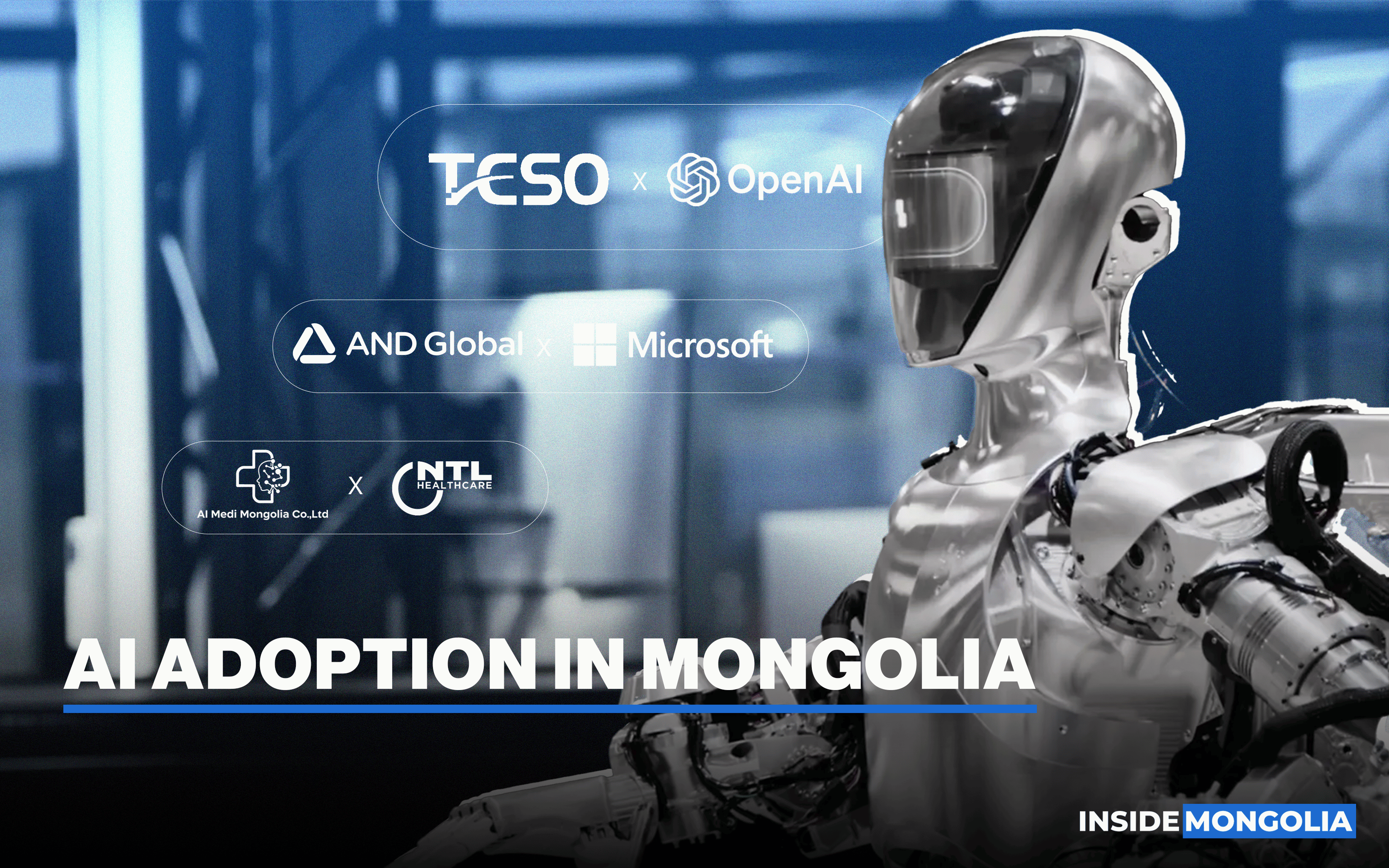
Last Friday, Mongolian conglomerate TESO Group announced a strategic partnership with OpenAI, marking one of the country’s biggest AI-related developments to date. It is definitely the perfect time to see how AI integration is progressing in Mongolia.
🇲🇳 Above the Midpoint
Mongolia’s AI adoption rate rose from 12.6% in the first half of 2025 to 14.3% in the second half, up 1.7 percentage points. That placed the country 69th out of 147 economies globally. Meanwhile, Google Trends data show that average search interest related to ChatGPT over the past year reached 68 out of 100, suggesting that public interest has remained relatively stable and high.
🧑🏻💻 Youth Usage: In Ulaanbaatar, people aged 15 to 34 use AI 3 to 4 times a week on average, with students increasingly turning to it for their studies.
🌏 Global average 1 in 6 people: By the second half of 2025, 16.3% of the global population had adopted AI, according to the Microsoft AI Economy Institute, with the UAE leading at 64% among 147 countries surveyed.
👔 At the Business Level
AI adoption among Mongolian companies and institutions has accelerated over the past 2 years, particularly across conglomerates, fintech, healthcare, media, and HR. TESO Group recently said it will deploy OpenAI’s technology across manufacturing, supply chains, sales, marketing, R&D, customer service, finance, and internal systems to improve productivity, decision-making, and innovation.
😎 Before that, AND Global and its subsidiary, AND Solutions, emerged as early Microsoft AI partners in Mongolia, launching Mindox, an AI-powered document-processing platform built on and optimized for Azure, which was later introduced to financial institutions in the Philippines and other Asian markets.
🩺 In healthcare, AI Medi Mongolia is working with South Korea’s NTL Healthcare to roll out CerviCare AI for early cervical cancer detection, while Tavan Bogd’s Nura Mongolia has been expanding advanced AI-based health services, including AI-assisted CT imaging.
Overall… From SMEs adopting AI chatbots and AI agents to large conglomerates partnering with global technology leaders, AI integration is clearly gaining momentum in Mongolia. In the years ahead, the use of AI across the business landscape is likely to expand further, intensifying competition and reshaping how companies operate.

The best HR advice comes from people who’ve been in the trenches.
That’s what this newsletter delivers.
I Hate it Here is your insider’s guide to surviving and thriving in HR, from someone who’s been there. It’s not about theory or buzzwords — it’s about practical, real-world advice for navigating everything from tricky managers to messy policies.
Every newsletter is written by Hebba Youssef — a Chief People Officer who’s seen it all and is here to share what actually works (and what doesn’t). We’re talking real talk, real strategies, and real support — all with a side of humor to keep you sane.
Because HR shouldn’t feel like a thankless job. And you shouldn’t feel alone in it.

Partnership Inquiries:
Place an ad
Publisher: Ts.Ankhbayar
Writer: M.Khulan
Graphics by: Ts.Tselmeg
Disclaimer: The information Inside Mongolia provides is for educational and informational purposes only. It is not intended to be or constitute financial advice, trading advice, or any other advice. The decision whether to consider the information we provide is solely our readers' independent decision.