- Inside Mongolia
- Posts
- 🫣 SOE Debt Crisis Deepens
🫣 SOE Debt Crisis Deepens
South Korea’s T-money Leaves Mongolia After a Costly Decade
In partnership with

Hello readers! At this point, Mongolia is basically running on politics alone: new government, new ministries, new speaker, and probably new surprises by the time you finish reading this. No one can actually predict the future, so why not make our own predictions? What happens next? Share your thoughts with us. 🧐
What’s inside today’s edition…
🆕 New Cabinet, New Speaker
💸 South Korea’s T-money Leaves Mongolia After a Costly Decade
🤕 SOE Debt Crisis Deepens
We’ve got a lot to cover, so let’s get moving. 🐐

MARKET
KHAN: Fitch Ratings assessed Khan Bank as financially stable and continuing to benefit from Mongolia’s economic growth, with its Tier 1 capital ratio remaining broadly steady at 17.5% at end-2025 versus 17.8% a year earlier.
BOM: As of the end of the first quarter of 2026, Mongolia’s foreign exchange reserves reached $7.2 billion, up $182.5 million since the beginning of the year, setting a new all-time high.
MNG: The 35th Prime Minister, N.Uchral, has formed his government, while S.Byambatsogt was elected as Mongolia’s new Parliament Speaker.

🚌 Mongolia’s Public Transport Revenue Spikes 69% After T-money Exit
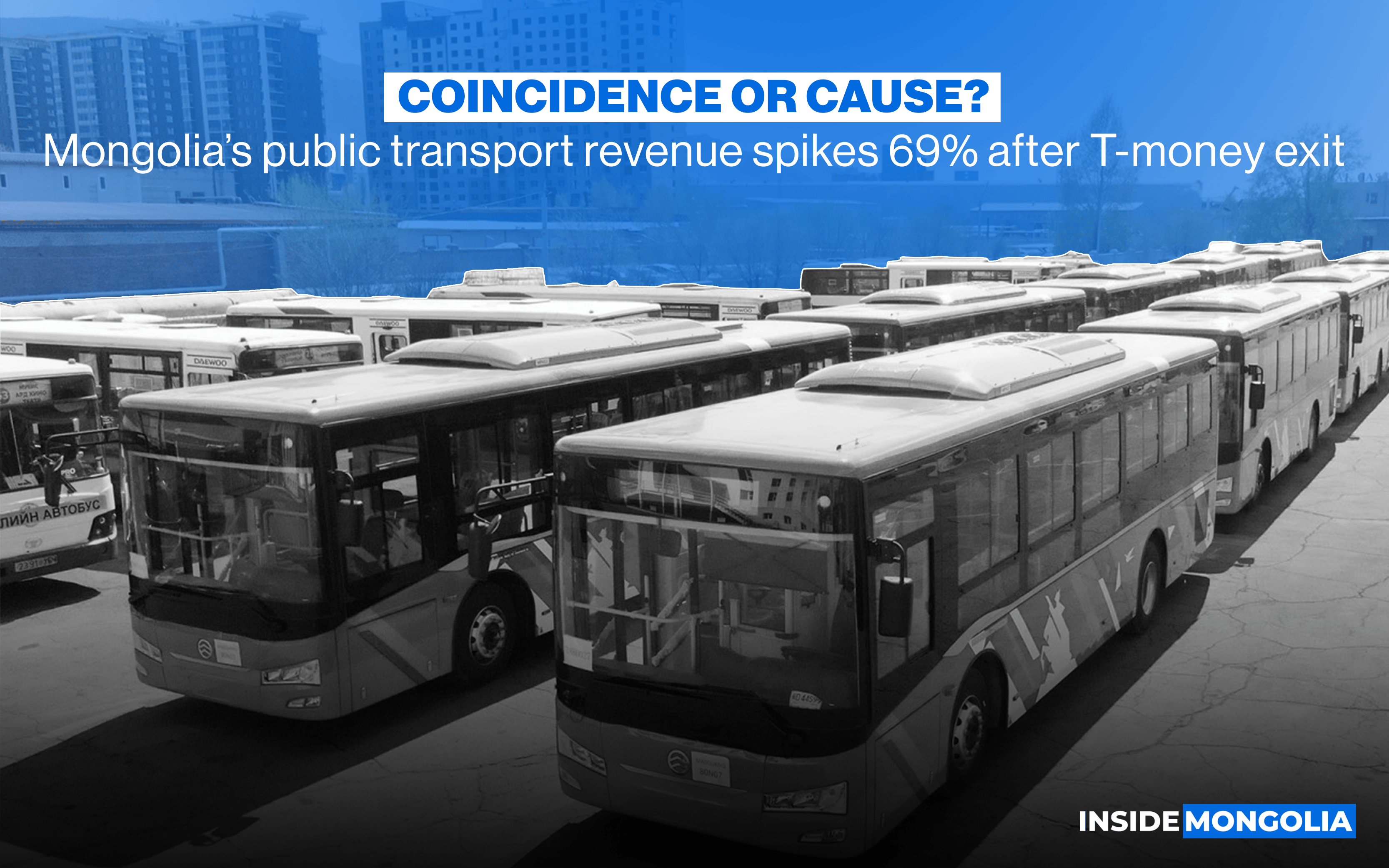
South Korea’s smart transit payment operator T-money has officially exited Mongolia, transferring its 55% stake in Ulaanbaatar Smart Card LLC to the city government in May 2025.
⛓️💥 As a result, the city’s ownership rose from 24% to 79%, giving it full controlling rights over the capital’s public transport payment system.
📃 Briefing the History
T-money first entered Mongolia in 2015 to roll out the U-Money system based on Seoul’s model, managing card issuance, top-ups, fare settlement, and the system’s technical infrastructure. However, the project remained unprofitable for a full decade, recording an estimated ₩21.6 billion in cumulative losses.
👉🏻 According to the company’s audit report, the main reason was structural, fares and service fees were largely determined by government policy, while fare increases were minimal over the years, making it difficult to build a commercially viable model.
💸 A Costly Exit, A Strategic Shift
Mongolia became one of T-money’s largest loss-making overseas projects. The company’s share of the loss from its 55% ownership is estimated at around ₩12 billion, including ₩4 billion in foreign exchange losses. The exit also reflects a broader strategic shift. After shutting down operations in the US in 2016, Malaysia in 2023, and now Mongolia in 2025, T-money appears to be moving away from directly owning overseas subsidiaries and instead repositioning itself as a technology provider and transport systems consultant.
🏙️ After the Exit, Revenue Starts Climbing
In early 2025, Mongolia doubled public transport fares for the first time in 11 years, from ₮500 to ₮1,000, just months before T-money’s exit. Since gaining greater control, Ulaanbaatar has expanded the payment system beyond the U-Money card, allowing passengers to pay with bank cards, mobile apps, QR codes, or cash.
🤾🏻 The impact has been immediate. Public transport revenue rose from ₮33 billion in 2024 to ₮56.7 billion in 2025, marking a 69% increase. In the first 2 months of this year alone, revenue increased by ₮1.4 billion year-on-year, while passenger numbers climbed 8.5%.
Finally... After years of losses under the previous model, the sector is now beginning to show signs of financial improvement under city-led management. But who knows how long the city can sustain this achievement...
⭐ Selected for you
ECONOMY & BUSINESS
European Union Imports of Anti-Freezing Preparations and Prepared De-Icing Fluids From Mongolia. (TradingEconomics)
Moncement Building Materials LLC Signs MoU with South Korea’s Carbon Star Co., Ltd. (Moncement)
POLITICS
Ambassador of Mongolia to Kyrgyzstan Sodnom Gankhuyag Completes His Diplomatic Mission. (AKIPress)
Dual Transition Project Launched in Mongolia With The Involvement of the Czech Organisation People in Need. (MZV)
Notable Partnership in Mongolia’s IPTV Sector: Univision and HBO Max. (LemonPress)
CULTURE & LIFESTYLE
Morin Khuur Craftsmanship Program Commences. (UBPost)
New Race Across The World Series Tests Relationships on a Global Trek to Mongolia. (TheIndependent)
Mongolia Arrive as the Team to Beat at FIBA 3x3 Asia Cup 2026. (FIBA)
Mongolia’s Devotion vs. Southeast Asia’s Mixed Feelings: What Explains the Different Receptions of K-Culture? (MaeilBusiness)
Where Did Bronze Age Mongolians Prepare Their Feasts? (ArchaeologyMagazine)
Fact Check: Mongolia Burial Ground Dating to Han Dynasty Miscaptioned as Gaza Grave. (ReutersFactCheck)
🫣 SOE Debt Crisis Deepens
Mongolia’s state-owned enterprises are grappling with a growing debt crisis, and since 2023, their debt has doubled to ₮11 trillion.
🤕 How Big is the SOEs Debt?
This is nearly 1/3 of the country’s ₮32.9 trillion national budget for 2026, and it also accounts for 24% of total national debt. Of this, ₮7.2 trillion is short-term and must be repaid within a year, while ₮4 trillion is long-term. Short-term obligations include ₮3 trillion from pre-collected revenue, ₮3.4 trillion from other sources, and ₮0.2 trillion from bonds, highlighting urgent repayment pressures. Back in January 2025, 44 non-mining SOEs were merged under Erchist Mongolia LLC to improve management and governance, but the initiative has since failed.
🏚️ Erchist Mongolia LLC Fails: The company recently faced liquidation after operating at a ₮3.5 billion loss, and it failed to manage its own operations, let alone address the losses of other SOEs. A company leaving this much debt within a year would be impossible anywhere except under state ownership, which underscores how deep the SOE debt problem has become and why urgent solutions are needed.
🌐 Government External Debt Remains High
As of Q4 2025, Mongolia’s external debt from multilateral and bilateral lenders totals ₮23.1 trillion, while the country’s total external debt is around ₮32 trillion. 53% of the bilateral/multilateral debt is owed to multilateral lenders, and 47% to bilateral partners. Major multilateral creditors include the Asian Development Bank with ₮7.7 trillion and the World Bank with ₮3 trillion, while key bilateral lenders are China with ₮3.9 trillion, Japan with ₮2.8 trillion, India with ₮1.4 trillion, and South Korea with ₮1.3 trillion.
💱 Currency Exposure Highlights Vulnerabilities: Debt exposure by currency underscores Mongolia’s dependence on foreign financing. 55% of this debt is in US dollars, 20% in IMF Special Drawing Rights, and the remainder in yen, euro, won, and other currencies. This makes repayment sensitive to exchange rate fluctuations and global financial conditions.
⚠️ Public Finances Under Strain
Rising SOE obligations, combined with high external debt, are creating mounting pressure on Mongolia’s public finances. Repayment deadlines and currency exposure pose serious risks that policymakers cannot ignore, and the newly appointed Prime Minister now faces the reality that the government itself carries huge debt. Any plan to privatize SOEs or increase transparency must first tackle the massive, unmanageable obligations weighing on the state.
Market Volatility Exposes Weak Delegation

When markets get shaky, advisors don’t just manage portfolios. They manage fear, questions, follow-up and a flood of client communication.
That’s where weak delegation gets expensive.
If meeting prep, paperwork, CRM updates and account admin still run through you, response times slip and the client experience takes the hit.
BELAY created the free Financial Advisor’s Delegation Guide to help you identify what to hand off, what to keep and how to stay client-facing without losing control.
Inside, you’ll learn how to reduce bottlenecks, protect responsiveness and free up more time for the work only you should be doing.

Partnership Inquiries:
Place an ad
Publisher: Ts.Ankhbayar
Writer: M.Khulan
Graphics by: Ts.Tselmeg
Disclaimer: The information Inside Mongolia provides is for educational and informational purposes only. It is not intended to be or constitute financial advice, trading advice, or any other advice. The decision whether to consider the information we provide is solely our readers' independent decision.